How to convert U-100 units and mL
A confirmed U-100 syringe scale has 100 units per milliliter. Divide the syringe units by 100 to find mL; multiply mL by 100 to find the equivalent marking.
Volume (mL) = U-100 syringe units ÷ 100
U-100 syringe units = volume (mL) × 100
U-100 syringe conversion chart
These are volume equivalents, not suggested doses or confirmation that a syringe can measure each amount.
| U-100 units | Volume in mL |
|---|---|
| 1 | 0.01 mL |
| 5 | 0.05 mL |
| 10 | 0.1 mL |
| 12.5 | 0.125 mL |
| 15 | 0.15 mL |
| 18 | 0.18 mL |
| 20 | 0.2 mL |
| 22 | 0.22 mL |
| 24 | 0.24 mL |
| 25 | 0.25 mL |
| 30 | 0.3 mL |
| 33 | 0.33 mL |
| 37.5 | 0.375 mL |
| 40 | 0.4 mL |
| 50 | 0.5 mL |
| 60 | 0.6 mL |
| 70 | 0.7 mL |
| 75 | 0.75 mL |
| 80 | 0.8 mL |
| 90 | 0.9 mL |
| 100 | 1 mL |
How many mL are 10 units on a U-100 syringe?
10 U-100 units = 0.1 mL. The calculation is 10 ÷ 100 = 0.1. In the other direction, 0.1 mL × 100 = 10 U-100 units.
How many mL are 22 or 24 U-100 units?
22 U-100 units = 0.22 mL, and 24 U-100 units = 0.24 mL. The same division applies to any entered value. Check the syringe’s actual printed lines separately; the mathematical conversion does not establish that a marking is present.
How to convert mL to U-100 units
0.2 mL = 20 units, 0.25 mL = 25 units, 0.5 mL = 50 units, and 1 mL = 100 units on a U-100 syringe. Multiply the volume in mL by 100. For another amount, choose “mL → units” in the calculator above.
Decimal values follow the same rule: 0.125 mL × 100 = 12.5 units, and 0.375 mL × 100 = 37.5 units. These volume equivalents do not establish that your syringe has a line at that position.
Does 100 units always mean 1 mL?
It does on a confirmed U-100 syringe scale. Other scales use different relationships, so this chart does not apply to U-40, U-500, or pen clicks. An amount labeled in international units (IU) describes biological activity; it cannot be converted to mL without the product’s labeled concentration in IU/mL. Do not assume an IU amount is a U-100 syringe marking.
Can I convert mg straight to syringe units?
You need the concentration first. The same 10-unit mark on a U-100 syringe is always 0.1 mL, but the amount of peptide in that liquid changes with concentration. There is no universal mg-to-syringe-units conversion. The peptide calculator connects your target mass, concentration, and volume.
Syringe capacity and line spacing are different
This converter checks volume against the capacity and line spacing you select. Capacity is the maximum volume a syringe holds; line spacing is the interval between its printed markings. A smaller U-100 syringe still uses 100 units per mL.
| Capacity in mL | Maximum U-100 units |
|---|---|
| 0.3 mL | 30 units |
| 0.5 mL | 50 units |
| 1 mL | 100 units |
Read the scale and smallest interval on your actual syringe. For example, five equal spaces between labeled marks 10 and 20 means each interval represents 2 units: (20 − 10) ÷ 5 = 2. Count the spaces between lines, not both endpoint lines. Capacity alone cannot tell you that interval.
A calculated 37.5 units equals 0.375 mL, but it falls between 37 and 38 on a scale with 1-unit lines. The arithmetic remains valid; it does not create a printed half-unit line. The peptide calculator checks the selected capacity and line spacing and shows between-line results with a measurement note, without rounding to a different amount.
Save a U-100 reference card
A compact reference for volume conversion, capacity and counting spaces between printed lines. The card contains no entered calculator values and supplies no target dose.
Download the U-100 reference card (SVG) · Print the blank practice worksheet
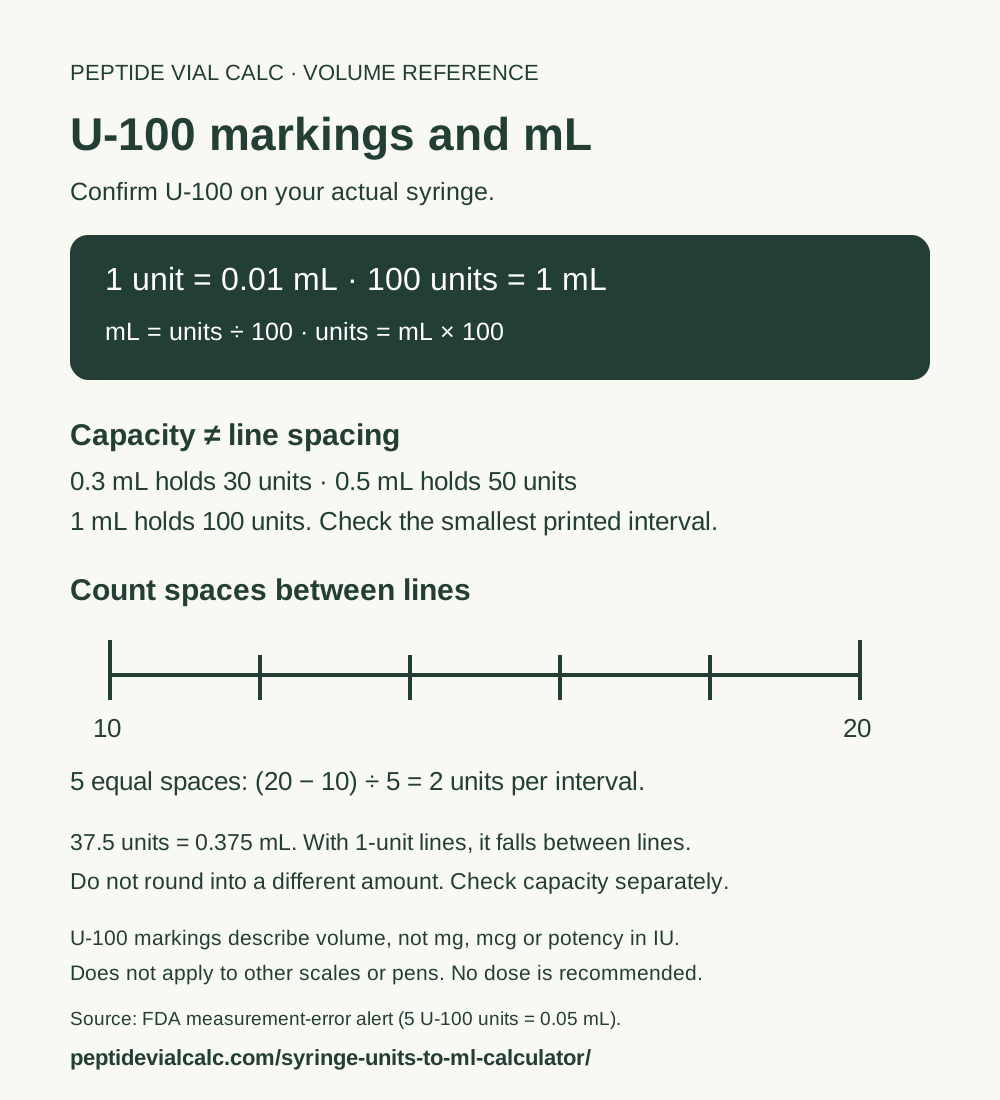
For an arithmetic disagreement involving mg or mcg, compare two concentrations. Volume conversion alone cannot identify the peptide mass.
Blank U-100 measurement worksheet
Print a blank reference for checking arithmetic and reading a confirmed U-100 scale. This worksheet does not select a dose or provide preparation instructions.
peptidevialcalc.com/syringe-units-to-ml-calculator/
1 U-100 unit = 0.01 mL · 100 U-100 units = 1 mL
mL = U-100 units ÷ 100 · U-100 units = mL × 100
| Capacity | Maximum U-100 units |
|---|---|
| 0.3 mL | 30 |
| 0.5 mL | 50 |
| 1 mL | 100 |
Count spaces, not endpoint lines. Between labels 10 and 20, five equal spaces means (20 − 10) ÷ 5 = 2 units per interval; ten spaces means 1 unit per interval. Capacity alone does not establish line spacing.
Confirmed scale: __________ Capacity: __________ mL
Lower label: ______ Upper label: ______ Spaces between: ______
Smallest interval = (upper − lower) ÷ spaces = __________ units
Amount to convert: __________ U-100 units ÷ 100 = __________ mL
Reverse check: __________ mL × 100 = __________ U-100 units
Within capacity? __________ On a printed line? __________
Values between lines remain mathematical equivalents, not printed markings. Do not round to another amount. A value beyond capacity cannot be shown on that syringe. U-100 markings are volume, not mg, mcg, or drug potency in IU.
Source: FDA, “Dosing errors associated with compounded injectable semaglutide products” (U-100 example: 5 units = 0.05 mL). Read the FDA source. fda.gov/drugs/human-drug-compounding/fda-alerts-health-care-providers-compounders-and-patients-dosing-errors-associated-compounded The FDA does not endorse this worksheet. Reference updated September 16, 2026.
Conversion sources and calculation method
The FDA’s report on measurement errors illustrates the U-100 relationship with 5 units equal to 0.05 mL and explains why confusing mg, mL, and syringe units can cause errors. It does not endorse this calculator.
See our calculation methodology and software checks, or the peptide reconstitution formula guide for the additional concentration step needed to convert a target mass to liquid volume. Calculator entries stay in your browser and are not saved by this site. Content updated October 5, 2026.